

Solar For All
More than four million American homes now generate solar power. Getting the next forty million will require a different pitch. More than just better panels, but a better deal.
Given the current political climate, there’s a lot of talk about numbers.
The price of oil.
The cost of war.
Percentages of inflation.
But there is another number I want to talk about today.
Twenty. Or rather, twenty years.
20 years is the standard term for a rooftop solar lease or power purchase agreement. It is longer than some mortgages. Longer than most marriages. Longer than most careers at a single company.
And for a technology that is supposed to be about freedom from utility bills, from fossil fuels, from grid dependence, it has always been a strange ask.
But what if the contract were three years instead?
That is the bet Terra Energy, a Miami-based solar company founded in 2016, is making. And based on the numbers so far, it may be on to something.
8,000+ installations across North America
98% customer renewal rate after year three
$105M in new financing, closed January 2026
The problem with solar’s golden age
Here is something that rarely gets said plainly: the residential solar industry has a customer experience problem. Not a technology problem. Not a cost problem. A complexity problem.
Since 2010, the price of solar panels has dropped by more than 90%. Installation has become faster and more reliable. Battery storage has improved dramatically. And yet, the paperwork for going solar still resembles a mortgage closing.
You choose your installer. You negotiate financing through a loan, a lease, or a 20- to 25-year power purchase agreement. You get your roof assessed. You wait for permits. You worry about what happens if you move.
For many homeowners, especially those without good credit scores, the rational response is to wait. And waiting has a compounding cost, both for household budgets and for the grid.
“Our approach is to make a product that is very digestible and easy to sign up for from the customer side — it’s a short-term commitment like a car lease or cell phone service.” — Jaime Martinez, Terra Energy CEO
What is Terra doing differently?
Terra’s model borrows its logic from the subscription economy. The company owns the solar equipment. It installs, monitors, maintains, and insures it. The homeowner pays a fixed monthly rate (with a 1.9% annual escalator) and sees their utility bill cut by up to 50% from day one. No upfront cost. No liens on the home. No 25-year lock-in.
The initial agreement is 36 months. After that, homeowners can renew, upgrade, or cancel. That flexibility is not just a marketing tactic; it is the company’s core theory of trust-building.
Rather than extracting a decades-long commitment from a customer who might not even be in the same area in five years, Terra is betting it can earn loyalty by actually delivering on its promise, year after year.
That 98% renewal rate suggests the strategy is working.
The company calls its in-house oversight platform Terralink, and it is vertically integrated, handling system design, installation, monitoring, service, and support in-house rather than through subcontractors.
In markets like South Florida and coastal Texas, where hurricanes are not hypothetical, that level of accountability is a genuine differentiator. Terra says its installations are engineered to withstand hurricane-force winds, with detailed photo documentation at every stage.
The Houston test, and why batteries change everything
In early 2026, Terra moved into one of the most interesting markets in American energy: the deregulated electricity market around Houston, Texas.
Texas is a case study in grid vulnerability. Millions of homes lost power for days during the 2021 winter storm. The state’s independent grid, managed by ERCOT, is famously isolated from the rest of the U.S. system. And as summers grow hotter, demand spikes last longer and are more intense.
In this context, Terra is pairing its solar installations with 40-kWh battery systems, large enough to power a typical home through an outage. In Houston’s deregulated market, where homeowners can choose their electricity provider, the math tilts even further toward solar: customers who eliminate their per-kilowatt-hour distribution charges entirely can see savings well above the 50% figure the company advertises in regulated markets.
California is next. A Southern California pilot was approximately 30 to 60 days from launch as of mid-April 2026, according to CEO Jaime Martinez. That market, which is the largest in the country for residential solar, is one where the subscription model may face its toughest test, given the sophistication of existing solar customers and the complexity of utility interconnection rules.
Betting on the future
In January 2026, Terra closed a $105 million series of financings: a $35 million green loan from Breakwall Capital, equity from ARC PE and Azora Capital, and credit facilities from Banesco and First Horizon Bank.
Green loans carry specific requirements because the capital must be used for environmentally beneficial projects, verified by an independent review.
Breakwall, an energy-specialist lender, was willing to put its credibility behind Terra’s model, not just its near-term financials.
The investor calculus here is worth understanding. Residential solar companies have failed before, often because the economics of owning and servicing millions of rooftop systems over decades are harder than they seem.
SolarCity, once the largest U.S. residential solar company, was absorbed by Tesla in 2016 under significant financial strain. Sunrun and Sunnova have navigated persistent profitability challenges.
Terra’s shorter contract cycle changes the risk profile. Three-year agreements are easier to underwrite. They create more natural moments for technology upgrades. And they reduce the long-tail maintenance liability that has plagued longer-term models.
Investors are betting that the subscription model is a more durable business structure for residential clean energy.
The decentralization argument
Terra’s pitch to homeowners is about monthly savings. Its pitch to investors is about scale. But there is a third argument, and it matters to anyone who has watched the U.S. grid struggle under extreme weather: what distributed solar actually does for resilience.
The U.S. electric grid was largely designed in the mid-20th century around centralized power plants and long-distance transmission. It works well under normal conditions. It struggles under abnormal ones: heat waves that cause transmission lines to sag and fail, winter storms that knock out gas supply chains, hurricanes that take down poles and wires across entire regions.
A home with solar and battery storage is not immune to all of this. But it is insulated from some of it. And if thousands of homes in a region, each with its own generation and storage capacity, then communities begin to look less like passive consumers of central power and more like participants in a distributed network. Microgrids become possible. Load on the central grid decreases precisely when stress is highest.
This is the broader argument for residential solar that rarely comes up in the conversation about monthly bill savings. The energy transition is not just an environmental project. It is an infrastructure resilience project. And subscriptions that lower the barrier to entry are part of how that infrastructure gets built, one roof at a time.
A note for homeowners considering solar subscriptions
The subscription model is genuinely simpler than most alternatives, but “simpler” is not the same as “examine the fine print.”
Before signing, ask: What is the monthly escalation rate (Terra’s is 1.9% annually)? What happens if you sell your home mid-contract? Who owns the equipment and what are your end-of-contract options? What does the cancellation process look like after year three? How will the panels affect my roof? What happens to my roof when the panels are removed?
Comparing at least two or three providers, whether subscription or purchase, remains good practice regardless of how straightforward the pitch sounds.
Solar technology has been ready for a while. The financing, now, may be too.
The question is whether the customer experience catches up, and whether enough homeowners decide that a three-year commitment to lower bills and cleaner power is a reasonable place to start.
If this story made solar feel slightly more possible, pass it to someone who thinks it’s still out of reach. And if you want more on the companies quietly reshaping how we power our homes, I hope you subscribe.
The future is being built in places most people aren’t looking.
The Blueprint - Community Action
Have you ever wanted to do more than just read stories about change? We have, and that’s why we created our Community Action series, which details pathways for you to make helpful changes and positive impacts in your community!
This week’s community action is: Community Solar
Somewhere near you, there is probably a field having an identity crisis.
It might be a struggling farm where the economics no longer work. An underused county parcel. A brownfield too contaminated for housing but too small for industry. Land that used to produce something and now mostly imposes a tax burden and worry on whoever owns it.
And somewhere near that field, there are probably households, whether they be renters, apartment dwellers, people in shaded or older homes, who can’t access rooftop solar. Who are watching their electric bills climb and wondering if clean energy is really for people like them.
Jack’s Solar Garden, a 1.2-megawatt community solar farm on a 24-acre family property south of Longmont, Colorado, is proof that these two problems can be solved together. And more than that: it left behind an unusually detailed blueprint for how other communities can do the same.
5,500+ visitors who’ve toured the site to see agrivoltaics in action
~300 Colorado homes powered by the garden’s clean electricity
First, the story you need to understand
Byron Kominek’s grandfather, Jack Stingerie, bought the farm in 1972. For 50 years, it grew hay and alfalfa. By the time Kominek moved back in 2016, those crops weren’t paying the bills anymore, which is a story millions of small farm families know too well.
Kominek looked at solar as a lifeline. But Boulder County’s land-use rules classified solar as an industrial use on agriculturally designated land. The farm could have solar panels or be a farm. Not both.
It would have been easy to throw in the towel, but Kominek didn’t give up. He worked with researchers, advocates, and county officials to change the rules.
And it worked.
Boulder County amended its Land Use Code in 2018, creating a pathway for agrivoltaics, which is the practice of combining solar energy production with active agriculture on protected farmland.
The project went through a Special Land Use Review process and was approved with specific requirements: minimized soil disturbance, an ongoing plan to maintain agricultural integrity, and elevated panels to allow people and equipment to work beneath them.
That regulatory fight, unglamorous as it sounds, is the most replicable part of the whole story.
“Jack’s Solar Garden provides us the most comprehensive and largest agrivoltaics research site in the nation while also providing food access and educational benefits to the surrounding community. It serves as a model that can be replicated.” — Jordan Macknick, National Renewable Energy Laboratory
What’s actually happening under those panels
The “garden” in Jack’s Solar Garden is not a marketing metaphor. The site grows real food, over 25,000 pounds of vegetables, herbs, and berries since 2021, cultivated by Sprout City Farms, a Denver-based nonprofit. And they’re not the only people who wanted to work in Jack’s Solar Garden.
Audubon Rockies planted more than 3,000 perennials around the array to establish pollinator habitat. Researchers from NREL (National Renewable Energy Laboratory), Colorado State University, and the University of Arizona study crop yields, soil moisture, carbon sequestration, microclimate changes, and grassland health.
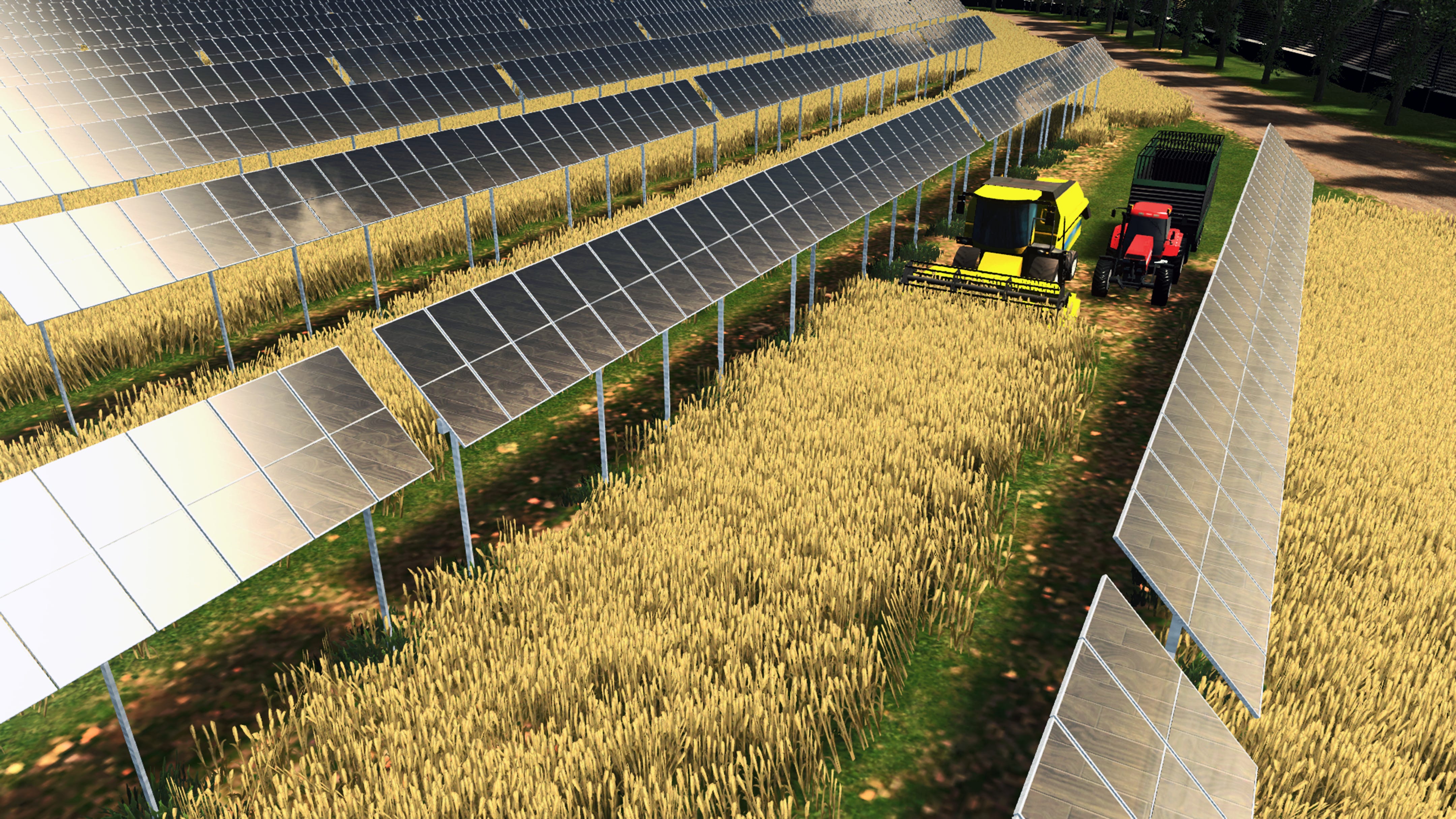
There’s a physical reason this works. Solar panels create shade. Shade lowers soil temperature and slows evaporation — which means crops beneath panels can need significantly less irrigation. When ambient temperatures spike and plants outside the array shut down photosynthesis, plants in the partial shade keep going. The panels themselves run more efficiently when they’re cooled by the microclimate below. The relationship is genuinely mutual: agriculture helps solar, and solar helps agriculture.
The project became the lead story in the BBC/PBS Earthshot Report 2024. It hosted the 2024 World Agrivoltaic Conference. Colorado Governor Jared Polis visited the site to sign legislation funding agrivoltaics research statewide. From a single struggling hay farm, it became a reference point for the entire global field.
How the money actually works
Jack’s Solar Garden was not funded by a grant. The solar array was financed through a bank loan, which is paid down by revenue from electricity subscriptions. Those subscriptions are sold to households, businesses, and local governments, including Boulder County and the City of Boulder, who receive monthly bill credits through Xcel Energy’s Solar Rewards Community program proportional to their share of the garden’s production.
Subscribers can sign up for 5, 10, or 20-year terms and choose the number of panels based on their annual electricity usage. The farm also donates 2% of its production to low-income households through the Boulder County Housing Authority.
Separately, $40,000 in county agricultural grants supported the Colorado Agrivoltaic Learning Center — the nonprofit and educational arm of the project — not the solar array itself.
The model matters because it’s self-sustaining. The farm produces energy; the energy sells subscriptions; the subscriptions pay off the loan. No ongoing public subsidy required for the core operation.
So: could this happen in your community?
Possibly yes. More likely than you’d think. Here’s what you need to know to find out.
Where community solar already exists: As of early 2026, 24 states and Washington D.C. have laws enabling community solar programs. 20 of those include specific provisions for low- and moderate-income households.
Arizona California Colorado Connecticut Delaware Hawaii Illinois Louisiana Maryland Massachusetts Minnesota Montana Nevada New Hampshire New Jersey New Mexico New York North Carolina Oregon Rhode Island South Carolina Vermont Virginia Washington D.C.
Not on this list? Community solar has been deployed in 41 states regardless of enabling legislation. Florida, Texas, Georgia, and others have voluntary programs that have grown significantly without state mandates.
One important heads-up for 2026: The federal 30% Investment Tax Credit for residential solar expired at the end of 2025. The economics of new community solar projects now depend more heavily on state incentives, net metering rates, and local utility programs. This makes local policy advocacy more important than ever, and makes existing programs in states with strong incentives especially worth joining now.
Six Honest Steps
Number One: Find out what’s already available in your state
Before organizing anything, check whether your state already has a community solar program you can simply subscribe to. If it does, joining an existing garden is the fastest way to access solar and demonstrate local demand. Contact your state energy office or utility’s renewable energy department.
EPA shared renewables state map →
Number Two: Map the land and the rules
The Jack’s Solar Garden story began with a zoning problem and ended with a code change. In your community, find out: what land is underused, what agricultural or conservation designations apply, and whether your county or municipality’s zoning code allows solar on that land. Many communities simply don’t have clear rules yet, but you should consider that an opening, not a dead end.
SolSmart planning & zoning toolkit →
Number Three: Talk to your local planning commission before a developer does
The most powerful moment in local solar permitting is before the first application is filed. Communities that proactively develop agrivoltaics guidelines, like Boulder County, end up with better projects than those that respond reactively. Ask your planning commission if they have a solar land-use policy. If not, you’ve just found a project.
Number Four: Build the coalition before you build the case
Jack’s Solar Garden worked because it solved problems for multiple groups at once: a farmer needed income, renters needed solar access, researchers needed a field site, and local government wanted a climate win. Before approaching officials, identify who else in your community has a stake: farmers struggling with land economics, affordable housing advocates, local food organizations, schools, faith communities, and small businesses with high electric bills.
Number Five: Demand equity provisions from the start
Jack’s Solar Garden reserves 2% of production for low-income households through the county housing authority. This wasn’t an afterthought; it was designed in. Whatever project your community pursues, push for explicit low- and moderate-income provisions before agreements are finalized. Of the 24 states with community solar laws, 20 already include some LMI provisions; use them as leverage.
Number Six: Use the resources that already exist
You don’t have to figure this out alone. The Colorado Agrivoltaic Learning Center offers educational resources and hosts visitors specifically so other communities can learn from Jack’s. SolSmart provides free technical assistance to local governments on solar permitting and policy. The USDA Sustainable Agriculture Research & Education program funds agrivoltaics research that farmers can apply for.
Colorado Agrivoltaic Learning Center →
Three things you can do right now
Starting a project is always daunting. You might have doubts about your qualifications to start. But here’s a secret… Anyone can do it.
You don’t need to be a developer, a lobbyist, or an engineer. Here’s where to start:
Subscribe to an existing community solar program if one operates in your state. You’ll reduce your bill and add a paying customer to a project that proves the model works.
Email your county planning department and ask: does our land-use code allow agrivoltaics on agricultural land? What would it take to change it? You’re not filing a proposal — you’re planting a seed.
Share this article with someone who owns farmland, works in local government, runs a food nonprofit, or is active in a faith community with a big roof and an electric bill. The coalition starts with one conversation.
Jack’s Solar Garden started because one person needed to keep a family farm alive. It became a global model because the idea was right: that the same acre of land can produce food, energy, community, research, and beauty, all at once.
The panels went up. The bees moved in. The vegetables grew. The bills went down. The farm survived.
That’s not a moonshot. That’s a blueprint.
If this gave you a place to start, pass it along. The clean energy future is already being built in places that look a lot like your community.
Thank You
If you’ve made it this far, then thank you. I created The Blue Marble to solve a problem in the media landscape: Too many people talking about problems, and not enough people talking about solutions.
We have all the tools we need to leave behind a better world than the one we inherited. We just need to implement them. And we do that by understanding the solutions to those problems.
We’re a reader-funded publication. If you can, consider upgrading to a paid subscription. It’s only $30/year, and that’s less than a dollar a week for these stories delivered straight to your inbox.
Ditch the doom. Hype the hope. Let’s build a better tomorrow together.